Friday, January 11, 2008

Banking sector crisis in the last quarter

We all know that the banking (credit services, mortgages, investment banking) industry has gone for a toss in the last few months in the midst of the credit/mortgage crisis in the United States. We've seen a lot happen, in the last quarter especially. Some of the big RIFs that I can remember -

(1) 08/2007 - Lehman Brothers cuts 1200 jobs and shuts down its BNC Mortgage Business at a one-off cost of $52 million
(2) 09/2007 - Countrywide Financial slashes 12,000 jobs. Countrywide is the nation's largest subprime lending mortgage company.
(3) 09/2007 - Key Bank slashes 200 jobs, including call center jobs.
(4) 10/2007 - Bank of America, the largest U.S. bank by market value, cuts 3000 jobs, mostly in the Investment Banking division - 10/2007
(5) 10/2007 - Morgan Stanley cuts 600 mortgage jobs
(6) 12/2007 - Washington Mutual slashes dividend and cuts more than 3000 jobs
(7) 01/2008 - National City cuts 900 jobs and slashes dividend by 49%, and stops offering mortgages thro' brokers - 01/2008
(8) 01/2008 - Merill Lynch announces that it may cut upto 1600 jobs (10%) and unveil writedowns of as much as $10 billion from Q4. Merill was the largest underwriter of 2007.
(9) But the worst of all, came from Citigroup in 04/2007, which their then CEO Charles Prince announced that Citi may cut around 45,000 jobs during the year. Yes, he was made to leave the organization (Cramer had been long telling that Chuck should be fired), and given the market condition, there was no one (from outside and inside) willing to take up the job. Can you beat it? I mean, Citigroup is the world's largest bank and no one wants to lead it! Finally, Vikram Pandit, who was with the organization only for 6 months decides to step in and he gets sworn in as the new Citi CEO. Let's wait and watch if he turns around things. Well at least today, he's got the Saudi billionaire prince Alwaleed to invest in the bank, so that's definitely a good move.

So, where does one go if everyone else around is also cutting jobs?

Among the few that survived, is Goldman Sacchs which turned out to have a great record-breaking 2007 reporting $3.17 billion in Q4 profit. One man's meat - another man's poison?

Now, just today, Bank of America announces one of their stupidest bids ever. They've placed a takeover bid of $4.2 billion for the company that probably was the root cause for this whole credit crisis - Countrywide. I agree, it is a good number for such a huge organization, so from that perspective it may be a good bid. Nevertheless, I think it is gamble in the wrong direction - it's assets and stock prices have been continuously deteriorating.

Where is all this heading? Certainly towards a recession in 2008, with oil prices touching $100 / barrel recently to add to market crisis. Will a change in the government add any value to the current situation? The Democrats, Clinton and Obama are looking towards the economy in their campaigns and caucus speeches, but would they just be speeches? What can the government do? What is the Fed doing? Is Bernanke a failure successor to Greenspan? Or can he do anything?

Labels: ,

Thursday, August 16, 2007

More problems at Dell....

Dell, the world's second largest PC maker based at Round Rock, TX, said today that it has to restate its last 4 years of financial results due to potential manipulation. It expects the restatement to reduce the net income by around $150 M, which is actually not much when compared to the $12 B that it made during this same restatement period. Revenues would also reduce by 1%. So the changes are minimal, but nevertheless their reporting problems continue. The review identified evidence that certain manpluations and adjustments seem to have been motivated by the objective of attaining financial targets.

This is the common reason behind most cases of earnings manipulation, and we know that Dell still faces SEC investigations for prior misconduct. In the in-process audit that began in August 2006 after similar accounting problems, around 125 lawyers and 250 accountants reviewed more thab 5M documents (that's big!!) and conducted more than 200 interviews with the company employees.

We've noticed a lot of changes since then, with the most prominent ones being -

- Michael Dell returned as Chief Executive in January, replacing his protege Kevin Rollins
- They recently broke from their long successful direct-to-consumer sale strategy and have started selling their computers at Wal-Mart. This actually disturbs me a little. Dell, being based at Austin, TX, used to find its way into almost all our business school case studies, be it Information Mangement, or Operations, or Strategy, or even Finance (well, nowadays, it can start featuring in the Accounting classes as well, on how NOT to do accounting :-) ). And in almost every class that I've attended we've discussed the direct-sales model of Dell. I envy the future generations who don't have to go through that trauma anymore. Nevertheless, they still remain our biggest recruiter at UT, absorbing more than 25 interns on a consistent basis...

But, what's the future of Dell? Well, I guess they really have to find their way out of the labyrinth of improper accounting that they are in now and regain confidence among the customers, shareholders and employees. I will think twice before I buy a Dell PC, think 5 times before I invest in the company and think 10 times before I decide I want to work for the company. No, don't get me wrong, I like the company, Michael's a great founder and CEO and I'm sure he's already turning things around for the company, but yet, they have to straighten themselves a bit - they are lucky to get away with this mal-reporting as they have to restate only a small percentage this time, but.....

Labels:

Thursday, June 21, 2007

Borsa Italiana to merge with LSE


Heard something interesting today. We've all been long aware of the fact that Nasdaq has pursued the buy the London Stock Exchange (LSE) at least twice in the recent years. While the bids were being turned down by LSE, now they come up with talks with Borsa Italiana for a smashing merger. This combination would have listed on it, companies valued more than $5.1 trillion!

This is a clear indication of globalisation and consolidation of international financial markets. Exchanges worldwide have never been under such pressure before as they are now , from their shareholders, to merge in order to cut costs and offer a broader range of products at the same time.

We have to wait and see how Nasdaq responds to this. But I think they should still pursue the larger LSE even if this deal with Borsa Italiana works out. The European tinge could add more flavor to Nasdaq.

Labels:

Microsoft succumbs to Google on antitrust allegation

In response to complaints from Google, Inc., Microsoft agreed to change its Windows Vista software in advance of a court hearing that will review its compliance with a 2002 antitrust settlement. Haha! Looks like they are getting to be proactive these days on the antitrust front. So, if they knew they were wrong, I'm curious if they are committing these antitrust crimes hoping that competitors don't file them? Well, maybe you have to do such things when you get big.

Google alleges Microsoft that Vista makes it hard for consumers to use rival desktop-search applications provided by Google and others. Microsoft, which denied the claims, however said the company was willing to alter Vista if required. It looks like they've seen and experienced enough of this anttrust stuff - primarily from the Windows Media Player antitrust lawsuit in the EU and now it is desktop search! You might think - is this illegal? No, it is not illegal, but it is unfair competition and does not stand a chance under the antitrust regulations both in the EU and in the US.

As usual, these changes to Vista software are expected to go out with their Service Pack-1 release awaited later this year, which would also include fixes to other security problems and bugs......amidst, of course, other new bugs.....

Labels: ,

Friday, June 15, 2007

Tax Boost for PE firms going public


Federal lawmakers on the Senate Finance committee launched a bipartisan bill against the blooming Private Equity market on the eve of the much awaited IPO of Blackstone Group. Historically, when hedge funds and buyout firms which are structured as private partnerships, become publicly traded, they enjoy the benefits of behaving like a corporation but pay taxes at the lower rates of partnerships. This bill introduced in the Senate, changes this agreement by raising the tax rates for private equity firms going public.

"It's unfair to allow a publicly traded company to act like a corporation but not pay corporate tax, contrary to the intent of the tax code."

People involved in the Blackstone IPO said that this bill could hit Blackstone's $40 billion valuation by as much as 20% !! Boy, that is huge and this also means that they may not be able to proceed with the IPO as planned and may have to defer the offering. This bill is definitely a blow to these hot buyout firms like Blackstone and KKR.

Blackstone has been amongst the most prominent PE firm with their audacious deals that range from their $39 billion takeover of the nation's largest ownwr of office buildings namely Equity Office Properties to Freescale Semiconductor. As one would expect, they are already indulging in some extensive lobbying to get a headstart against their rival firms intending to go public.

I think this is a good move and the bill should get passed both in the House and the Senate. It is a totally unfair rainbow that the PE firms are currently enjoying when they go public, unfair against the corporations and other startups going public.....All should be treated on par and taxed at the corporate rates. But will Blackstone going public escape this? Or has the bill been introduced at the right moment to stop it from going public?

Labels:

Friday, February 02, 2007

Dell, Accounting Scandal and Investor Lawsuit


It was not long after Kevin Rollins was fired a day ago (well ok, resigned), that Dell investors filed a lawsuit against the computer maker's accounting practices in its longtime partnership with chipmaker Intel.

  • Dell's deal with Intel
    • Dell has been receiving 'rebates' from Intel for a long time every year to the order of $1 billion per year
    • Agreement was to use only Intel chips in Dell computers, (and not AMD's)
    • Intel had urged Dell to keep this deal secret to due to fear of antitrust lawsuits (unfair competition) against Intel across the world
    • So, the deal was maintained secret, known only to 15 senior people within the organization
    • And we know, anything "secret" in a public company, is "likely illegal"
  • Lawsuit -
    • Seeks class-action status on behalf of Dell shareholders
    • Filed here in Austin
    • The 'rebates' that Dell received are termed 'e-cap payments' (exception to corporate average pricing)
    • Fraudulent accounting - Dell's profits have been reported inflated by hundreds of millions of dollars
    • The $1 billion a year that Dell received was spread 'unevenly' across the 4 quarters, and the money was applied to reduce COGS (cost of goods sold) on the Income Statement - (Intel must be cursing Dell for this). In other words, they recognize this revenue as and when they want, depending on their quarter's performance. This is not conformant with US GAAP.
    • More, since 1999, Dell started making computers with AMD chips, again "secretly" - because the deal with Intel was still on - I seriously don't know how they got away w/ this.
  • AMD vs Intel
    • vigorously competing against each other for market share - with AMD doing better in the recent run
    • With this investor lawsuit against Dell, AMD jumps to the occasion and sues Intel for unfair marketing practices - I totally agree, this is an unethical fight for monopoly which is illegal under the antitrust regulation. Even if Intel gets away with this at U.S, I'm sure the EU will not tolerate that

  • So, now what?
    • Huge reputation damage for both Dell and Intel. More for Dell because, fraudulent accounting practices are far more illegal than antitrust.
    • PWC is Dell's defendant (Remember what happened to Arthur Anderson after the Enron drama?)
    • If I were working at Dell, I would have considered quitting, not because of the dropping share price or losing market share but just because the top management had a secret deal going on without letting the shareholders and employees know about it.

Labels:

Saturday, December 30, 2006

AT&T gets Bell South, but we get Net Neutrality!

Yes, as predicted, after intense public pressure, AT&T executives agreed to adhere to Net Neutrality conditions in order to secure FCC approval for their merger with Bell South. It is a significant victory for us to protect network neutrality. It is now upto the new Congress to finish up the work of the FCC and make Net Neutrality permanent under the law.

If you haven't been following what's been happening on this front, take this opportunity to read what Tim Lu, Professor of Law - Columbia University has to say.

Or even easier, just watch this high-rated SaveTheInternet's video of YouTube.

Labels: ,

Thursday, December 21, 2006

McDowell says he won't vote on the AT&T-BellSouth deal

WSJ Premium Uncut

I remember posting about a year ago, about SBC's takeover of AT&T for close to $20 billion. If we then watched in wonder on how big the telecommunications industry is in the U.S (and around the world, of course), this is how big it can get. The new AT&T made a $86 billion (!!!) bid to buy BellSouth Corp. sometime back and was approved by the Justice Department without any conditions in Oct. 2006.

While we all know of the tremendously large potential cost savings that this merger could result in for these giants, we also must remember, as consumers, the reduction in price-based competition that seems obvious at this point.

However, the deal faces certain obstacles at this point, with telecommunications lawyer Robert McDowell said yesterday that he is not going to vote on the deal because of ethical concerns. The 5-member commission with 2 Democrats pusing for certain conditions and 2 remaining Republicans opposing them, was depending on McDowell's vote to decide.

Why this deal and McDowell's stance is interesting to me is, now the deal might not be allowed to happen under these conditions, but might require AT&T to abide Net-Neutrality conditions. This means that the firm must treat all Internet traffic equally, and is something that the Democrats are pusing for, and something that we've spoken frequently in this blog.
AT&T is working hard with the the FCC to get the deal approved and bring the merger review to a bipartisan completion as soon as possible.

Labels:

Tuesday, December 12, 2006

Private Equity firms to acquire Sabre Holdings Corp.

Who: Private equity firms Texas Pacific and Sliver Lake

Whom: Sabre Holdings Corp - a travel booking service

Deal: $4.5 billion in cash, plus the assumption of $550 million in debt

Cause and Effect:
  • Sabre, with a market cap of $4 billion, is enticing
  • Travelocity, Priceline.com and Orbitz are starting to show healthy growth again, although airlines have been decreasing the amount of inventory available to online ticket agencies
  • Orbitz, is now owned by PE firm, Blackstone Group - so there's some traffic heading in this direction
  • The overall PE market has been growing tremendously with LBOs. Lesser and lesser firms want to be taken public too, given all the regulations they need to go through for SOX compliance. So, PE and LBOs seem to be the new hot market for raising capital!
  • It has been announced that the same managment will be currently retained

Labels:

Thursday, October 12, 2006

What's the hype about this backdating option scandals?

We've seen a lot of these in the recent past, including big names like Apple, McAfee and BCGI.
So what's the deal here? What exactly is the scandal?

Options (referred as ESOs - Employee Stock Options) are typically designed to give recipients a stake in improving the company's share price by allowing them to purchase shares in the future at their price on the day the option was granted. By backdating grants to earlier days when the stock price was particularly low, recipients can get extra profit. So, for example, if my company gives me an option to buy stock at $20, when it is trading today at $25, the strike price would be $20 and market price would be $25, and my profit when I excersise the option would be $5.

So, it seems ok, right, this backdating? It was, when companies were just required to state details about option grants to management and employees, in their 10K notes or report. But recently in 2005, GAAP has mandated under the new FAS 123R, that all companies expense out (on their Income Statement) all options, even at-the-money options. So, in an attempt to boost their earnings (with lesser expenses), companies have started backdating their option grants to executives to a much lower strike price, so that they will have to expense out lesser. That's the scandal, becuase such artificial boosting of net income is absolutely not acceptable to shareholders!!

There has been at least 28 dismissals, suspensions and resignations of corporate officials amid probes of stock-option practices at their companies. More than 100 companies are facing scrutiny from federal regulators and prosecutors, who are focusing on the practice of improperly backdating options to make them more valuable to recipients. Yeah!

Refer to this page (it's a pretty cool one) if you want to understand backdating further...

Labels:

Saturday, October 07, 2006

Tensions at GM again

WSJ Premium

Billionaire investor, Kirk Kerkorian's designate on GM Board, Jeremy York (former Chrysler Corp. and IBM Corp. turnaround specialist) quit from the Board after a failed push to get the company to partner with Nissan and Renault, which came to a halt earlier this week. He acknowledged that the auto giant had made progress to reduce risks of bankruptcy, but at the same time he had grave reservations about the ability of the company's current business model and to successfully compete in the American market place.

Mr. Kirkorian's investment vehicle, Tracinda Corp., indicated serious doubts of whether he will retain his massive 9.9% investment in GM, which amounts to $1.6 billion. Investors pushed GM's stock down by 6.3% to $31.05 yesterday, with volumes nearly 8 times the norm. A fall of this magnitude adds around $120 million in losses to Mr. Kerkorian's investment.

Mr. York's exit exposed the long-running tensions in the GM Boardroom, and this can be a short-term success for CEO Rick Wagoner. But now, he faces the long-term challenges of overcoming GM's competitve ills and threats.

A very classical example of Principal-Agency conflicts!

Labels:

The Foley Fallout

CNN Uncut

Mark Foley, who quit as a Florida representative last month, is said to have sent sex messages over the Internet to teenage boys who had been congressional pages. Republican leaders, including Speaker Dennis Hastert, are accused of knowing about Foley's behavior and not stopping it to protect their political power.

The scandal has threatened to unravel the GOP's chances of maintaining control of both Houses of Congress, and Speaker Hastert has faced calls for his resignation.

Democrats are intensely using the Foley scandal to turn up the heat on Republicans, a month before congressional elections that put control of the House and Senate at stake.

Labels:

Saturday, September 09, 2006

HP Divided

2002 - Walter Hewlett, after HP's $19 billion acquisition of Compaq
2005 Feb - Ms. Fiorina
Now 2006, it could be their Chairman, Patricia Dunn's turn to depart from HP and its Board.

Yes, with $77 billion in total assets (of which $43 billion are current), one of the biggest Silicon Valley firms, HP, has been undergoing unusual upheavals in the recent years. The board has fluctuated between nine and 11 directors in the past 18 months, with multiple comings and goings.

The 2006 HP scandal: Ms. Dunn had helped prod H-P's board to examine Ms. Fiorina's performance and how well H-P had fared since its acquisition of Compaq in 2002.

Ms. Dunn authorized the probe into media leaks. After private investigators obtained phone records that showed director George Keyworth had spoken with a reporter, Ms. Dunn and H-P's general counsel, Ann Baskins, concluded the leak was a violation of the company's standards of business conduct.

And it gets worse. Now, California Attorney General Bill Lockyer yesterday said his office will probably file criminal charges related to the company's use of private investigators to obtain phone records of board members who might have been leaking to the news media. The investigators used "pretexting" -- calling a phone company to get a customer's information under the pretext of representing that customer -- a scam that has been a growing problem for phone companies and an even worse one for consumers, The Wall Street Journal notes.

A divided Hewlett-Packard Co. board is scheduled to confer by phone Sunday to discuss the future of Chairman Patricia Dunn and other fallout from an investigation of press leaks which authorities say may have violated California law. However, Ms. Dunn says she has no plans to resign. However, she said she would step down as both chairman and an H-P board member if fellow directors request it. "I serve entirely at the pleasure of the board," Ms. Dunn said. "If they determine it no longer is in the interest of shareholders" to remain chairman or a director, "I will do so."

And although this nixonian scandal is the talk of the Silicon Valley, surprisingly the street has not "yet" reacted much to it. HP shares hardly changed this week. That concerns me, because I'm beginning to wonder about the value that Ms. Dunn had been adding to the board then!

Labels:

Saturday, December 31, 2005

SAM: The TOP 5 Acquistions of 2005

Acquiror / Target : Deal Value

1. Proctor & Gamble / Gillette Co : $57 billion

2. Bank of America Corp. / MBNA Corp : $ 37 billion

3. Conocco Philips Inc / Burlington resources Inc : $36 billion

4. SBC Communication Inc / AT & T : $22 billion

5. Boston Scientific Group / Guidant Corp : $22 billion

Labels:

Monday, December 26, 2005

SAM: Scandal, Lies and Courtroom drama - Enron in the limelight

WSJ Premium Uncut

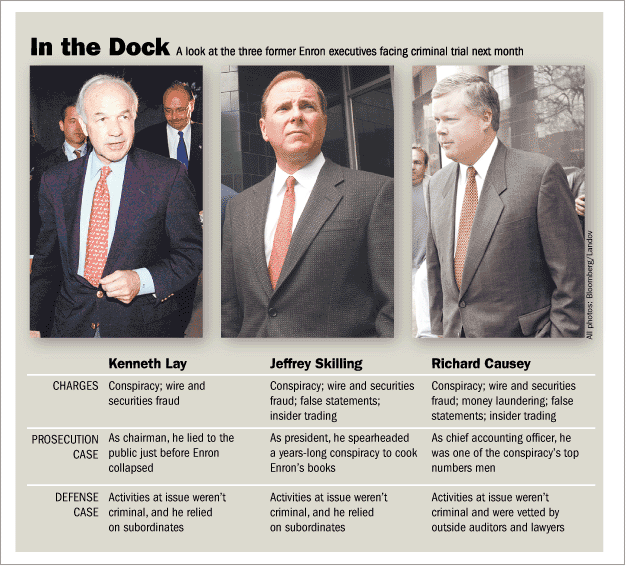
  • During onetime energy giant Enron's heyday, it was Chariman Kenneth Lay and President Jeffrey Skilling who held the spotlight. Cheif Accounting Officer Richard Causey worked in the b/g
  • Now its 45-year old Mr. Causey's turn to be at the center of courtroom drama and play an leading role in determining the criminal fate of his 2 former bosses in what promises to be the capstone trial of current era of corporate scandals
  • Cheif accountant, Mr. Causey had detailed knowledge of inner financial workings of Enron which, amidst questions about its finances and accounting, collapsed into Chapter 11 Bankruptcy in 2001
  • If all the 3 make it to the defense table, their unity will be tested as there are points of potential conflict
  • But all three have pleaded not guilty
  • What a way to start the new corporate year of 2006 with the trial set to begin at the federal court in Houston, TX, on Jan 17th!

Labels:

Saturday, December 24, 2005

SAM: Albertson's Inc - Collapse of Sale

WSJ Premium Uncut

Who: Investors - Cerberus Capital Management LP , Kimco Realty Corp
Retailers - CVS Corp., Supervalu Inc.

Whom: Albertson's Inc., 2nd largest supermarket chain in U.S (after Kroger Co.)

Competitors: Discounters like Walmart Stores Inc. , and quality stores like Whole Foods Market, other chains like Kruger and Safeway Inc.

Deal: Proposed, $9.6 billion

Cause and Effect:
  • CEO, Larry Johntson was originally brought to Albertson's from a strong track record spanning over 3 decades at GE. He was the comapny's first outside chief executive who won the job in 2001 over former executives of the firm.
  • Mr. Johntson was a shrewd cost-cutter, cutting over 30,000 jobs to reduce the workforce to 200,000.But his efforts to boost sales floundered due to heavy competition from Walmart's dominance of the food retail business.
  • While competitors like Kruger and Safeway lowered prices and improved merchandise quality, Mr. Johntson zigzagged b/w strategies that yielded only disappointing results
  • Albertson's shares have fallen 34% since the day Mr. Johntson was named chief executive.
  • Problems have increased over the last couple of years since 2003- SGA expenses have increased by around 16% to around $10 billion in 2005.
  • As a result, over this period its EBIT has fallen drastically by more than 30% to $1.2 billion in 2005, although sales increased by around 12% to around $40 billion
  • So, Albertson was up for sale. Supervalu was going to pick up several of Albertson's better performing divisions, CVS was going to take its freestanding drugstores. Kimco and Cerberus were planning to acquire a batch of their weakest stores, most likely to unlock their real estate value
  • While the deal was almost nearing completion, it suddenly broke down Wednesday over last minute disagreement over who should shoulder the responsibility if regulators tried to block the deal because of anti-trust concerns.
  • It was said that Supervalu assumed more of the risk that the federal anti-trust regulators would object that there would be competitive overlaps b/w Supervalu-owned stores and Albertson's stores. But Albertson's board demanded more concessions, and talks were called off
  • As a result, on Friday, Albertson's shares were down 12% to $20.54 as of 4pm on NYSE

Labels:

SAM: Equity firms to acquire Affiliated Computer Services

Who: 3 private equity firms including Texas Pacific (leading the deal) , Bain Capital and Blackstone Group

Whom: Affiliated Computer Services (ACS), Inc. based in Dallas, TX - a service oriented firm which processes transactions like employee-benefit changes and accounts-payables.

Competitors: IBM Corp, EDS Corp, Computer Sciences Corp.

Deal: Proposed, $8 billion

Cause & Effect:
  • ACS posted 25% rise in revenue to $1.31 billion, reported Sep. 30
  • Companies such as ACS are attractive to private-equity firms because they have the ability to generate steady cash flows, from their growth oportunities
  • These cash flows allow the owners to take more debt in this non-'Modigliani & Miller' world, backed by that cash and hence pay themselves larger dividends.
  • Since non-financial firms have largely remained on the sidelines this year, these investment firms take the advantage of the lack of competition to bid for these companies and also get attractive financing deals from the banks and bond market.
  • As a result of this proposed deal, ACS stock on the NYSE, rose 5% to $61 yesterday, in a market that was mostly flat Friday.
  • On the bond market, ACS's bonds that were trading near par, fell to around 90 cents on the dollar in anticipation of additional debt leverage that usually follows such buyouts.

Labels:

Thursday, September 01, 2005

Creative strikes, Apple bitten ?

CNN Uncut

Creative Technology, a maker of portable music players, said it was awarded a U.S. patent that applied to Apple Computer's iPod and other rivals. Yes, you are reading right. Creative said it had applied for the patent - dubbed the Zen patent after its Zen player -- on January 5, 2001 and it was awarded the patent on August 9, 2005.

"The Apple iPod was only announced in October 2001, 13 months after we had been shipping the NOMAD jukebox based upon the user interface covered by our Zen patent.", said Sim Wong Hoo, chairman and CEO of Creative. Creative said the patent covers the way music tracks are selected on a device using a hierarchy of 3 or more successful screens.

Creative ranks far behind Apple which holds 70% of the market share for music players that use hard drives to store music. Its shares rose 2.5% to close at $7.94 on Tuesday.

Well, I was holding Apple in high esteem with regards to its creativity and innovation power, be it on the MAC Tiger, or on the ever-famous iPod. But it seems like the iPod craze that Apple managed to steer also owes its credit to Creative (probably). We need to wait and watch for Apple's reaction to this. Nevertheless, the lesson learnt is, when launching a new product or technology, it is not sufficient to keep track of patents that have been awarded. One needs to also keep track to patents that have been submitted an indefinite number of years ago and are still awaiting clearance.

Labels: ,

JUST FOR KICKS